
Ghost Brand Skincare: The Marketing Technique I Didn't Know About
Buyer Beware: The Ghost Brand Technique I Didn't Know About
Have you ever added something to your cart because it was all over your For You Page—"Korean glass skin" in the caption, thousands of comments raving about it—and then just... never actually flipped the box over to read what's in it?
I'll be honest with you, I almost didn't either.
I had received one of these viral skincare sets as a gift to review for my audience, so I did what I normally do: I went looking for the company's website to learn more about the products.
And that's when something didn't sit right with me.
There was no full ingredient list on the website.
What?
Not only that. But no physical address for the business. No mention of where the products were produced. And most notably, no contact info. Nothing. Nada. Not an email, a chat button, or a phone number.
Here's the important part before I go any further: this isn't about calling out one company. What I found is a marketing and promotion trend that I was unaware of, and I want to bring it to your attention. Think of this less as "avoid this one brand" and more as "I learned a few things that I want to share with you."
🎥 Watch LIVE on my new YouTube channel, Michelle Fox Recommends
Thursday, August 20, 8:00 pm EDT

Follow my new Facebook Page too!
White Label Products
Here's what I learned digging into this. A lot of these viral sets are what's called white-label products, meaning one factory manufactures a formula, and then that exact same formula and packaging gets sold under a dozen different "brand" names by a dozen different sellers, each running their own storefront and social media account.
None of those sellers necessarily own a lab, employ a chemist, or even touch the product before it ships to you. They're a name, a logo, and a marketing budget wrapped around someone else's formula.
That's not automatically a scam. But it does mean there's often no real company standing behind what you're putting on your face, which is why I came up empty when I went looking for basic information about the company.
A logo and a marketing budget aren't the same thing as a company you can actually reach.
The Red Flags I'd Never Thought to Check For Before
Here's the checklist I wish I'd known to run through before this. If you're looking at a brand's website, especially one you found through a viral video or ad, check for:
A full ingredient list. Not just the trendy buzzword actives in the caption—the entire deck. If it's not posted anywhere, that's your first sign to slow down.
A physical address. Even a general one. A real business is registered somewhere.
Contact information. An email, a phone number, a working chat function—something that shows a human being is on the other end if you have a question or a reaction to a product.
Manufacturing info. Where the product is actually made, not just where it's marketed as being "inspired by."
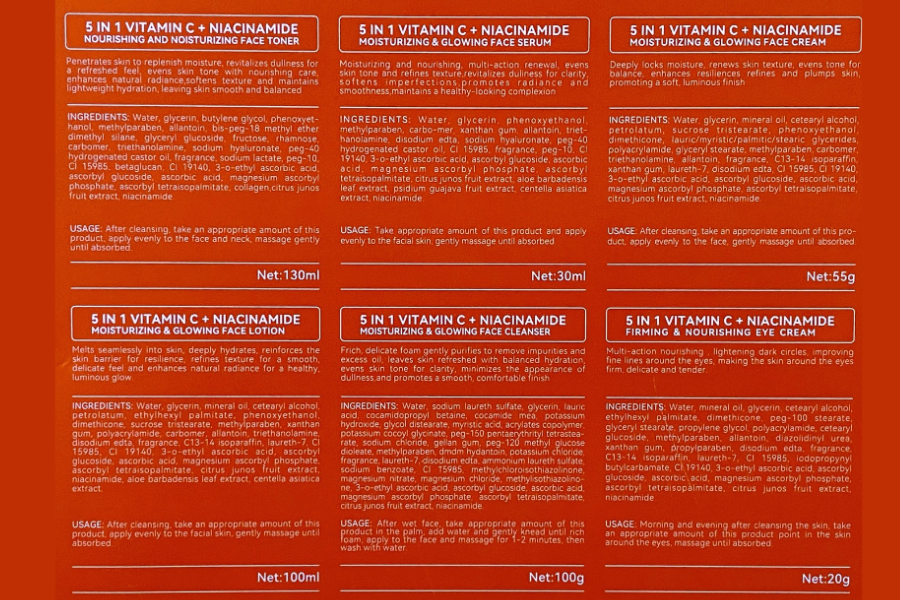
➡️ When I finally thought to look at the back of the physical box, there was a full ingredient list printed right on it — things like mineral oil, methylparaben and propylparaben, diazolidinyl urea, and fragrance. It existed. It just wasn't anywhere someone could find it before buying or using the product, which is really the whole point.
Where are the "hero ingredients"? 🦸🏻♀️
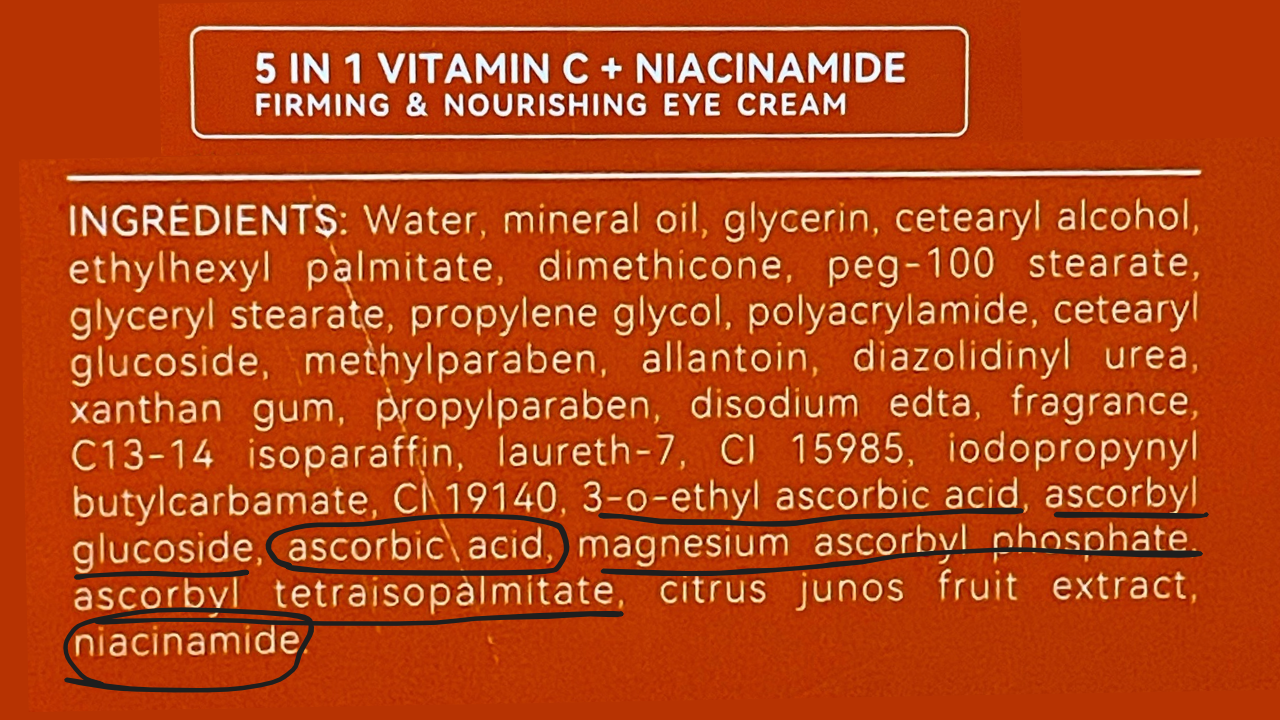
This is the part that really got me. The products in this set are literally labeled "5 IN 1 VITAMIN C + NIACINAMIDE" right on the front of the box. Those are the two star ingredients they're selling you on. So I went and found both of them on the ingredient list. Vitamin C shows up after the synthetic dyes. Niacinamide? It's dead last. The very last named ingredient before the list ends.
On a cosmetic label, ingredients above 1% are generally listed in descending order of concentration, while ingredients at 1% or less can appear in any order toward the end of the list. So when ingredients like Vitamin C and Niacinamide appear down there, we can't know their exact concentration from the label, but their position tells us they aren't among the highest-concentration ingredients in the formula.
There was no Ferulic Acid and no Vitamin E listed; two ingredients commonly used to help stabilize certain Vitamin C formulations. That doesn't automatically mean the Vitamin C is ineffective, because there are other ways to formulate and stabilize Vitamin C. But it does make me question how well this particular formula protects the Vitamin C from degradation.
Vitamin C can be notoriously unstable, particularly in certain formulations, and exposure to light, oxygen, and other environmental factors can contribute to degradation. Without knowing how this particular formula was stabilized and packaged, there's no way to know how much of that Vitamin C remains active by the time you use it.
So this is worth noting: the ingredients doing the marketing on the front of the box aren't always the ingredients doing the work inside it.
The two ingredients on the front of the box were the two buried at the bottom of the label.
The FDA and Cosmetics
Here's the thing a lot of people don't realize: the FDA doesn't pre-approve or test cosmetic products before they hit shelves. That hasn't changed. But the rules around accountability have gotten stronger.
Under a law called MoCRA, the Modernization of Cosmetics Regulation Act, cosmetic companies are now required to:
Keep evidence and records supporting the safety of their products
Report serious adverse events to the FDA
List a "Responsible Person" — an actual name and address — on the product packaging
Register their manufacturing facilities with the FDA
That last one is the big one for what we're talking about tonight. The FDA now has the authority to inspect records and order mandatory recalls when necessary — but all of that depends on there being a real, identifiable company on the other end. A name and address on the box isn't just good customer service anymore; it's a legal requirement.
So if there's no name, no address, and no contact info attached to a product, ask yourself: who exactly is accountable if you have a reaction? Who do you even call?
What I Do Differently With the Brands I Recommend
This is honestly why I've become so particular about the brands I choose to review and recommend to you. The brands I keep coming back to all have a few things in common:
A full ingredient list, posted plainly, no digging required.
A real address and a real "who we are" story I can actually verify.
A working way to contact them—and often, a person who actually responds.
Willingness to tell me exactly where and how their products are made.
➡️ That transparency is the difference between a company that wants a real relationship with its customers and one that just wants a sale. I'd genuinely rather introduce you to five smaller brands doing this right than one viral set I can't vouch for.
What I Want You to Do Going Forward
Search for the ingredient list before you buy, not after. If you can't find it, that's significant.
Look for a physical address and real contact info on any brand's website before you trust them with your skin.
Don't assume "viral" means "vetted." A trending video is marketing, not a background check.
Ask who's actually behind a brand you're considering. A quick search on the company name (not just the product name) can tell you a lot.
Final Thoughts
None of this is about shaming anyone for buying something that went viral on social media or was a crazy low price in an online marketplace. It's just that knowing who's actually behind a product and what's in it is really important!
I'll always tell you when I learn something like this, even when it's not the fun kind of post to write. That's the whole point of doing this together.
Come hang out with me over on my Michelle Fox Recommends YouTube channel, where I'm digging into things like this in real time — Click here to subscribe so you don't miss it.





Facebook
Instagram
LinkedIn
Youtube
TikTok
Pinterest